
Since June 5, 2026, the subsidy for self-consumption of photovoltaic energy has been eliminated, and surplus energy is now only bought back at 1.1 cents/kWh: installers can no longer sell solar energy using the argument «the government subsidizes part of it.» Leads to solar energy sales are now based on three verifiable factors: the value of the self-consumed kWh, the 5.5% VAT rate, and the ability to manage household energy usage.
- What will change for photovoltaics in 2026
- What arguments replace the bonus in your advertisements?
- The 5.5% VAT rate: the argument that requires a qualified installer
- Method: a photovoltaic campaign without subsidies, step by step
- Mistakes that drive away households and the DGCCRF
- Frequently Asked Questions
What will change for photovoltaics in 2026
The decree of June 1, 2026, published in the Official Journal on June 4, eliminated the investment subsidy and set a single feed-in tariff for surplus electricity at €0.11/kWh for installations up to 100 kWp. The self-consumption subsidy refers to the aid paid by EDF OA over five years to self-consumption installations with surplus sales; it was €80/kWp in the second quarter of 2026 for an installation of 9 kWp or less, or approximately €720 for 9 kWp, according to the CRE (French Energy Regulatory Commission) scales cited by photovoltaique.info. The feed-in tariff for surplus electricity was €0.04/kWh for the same installations between April 1 and June 4, 2026.
The new framework, applicable to complete connection applications submitted since June 5, 2026, is summarized in the figure below. CAPEB (June 2026) described the implementation as «abrupt,» as the government did not wait for the end of the quarterly tariff period.
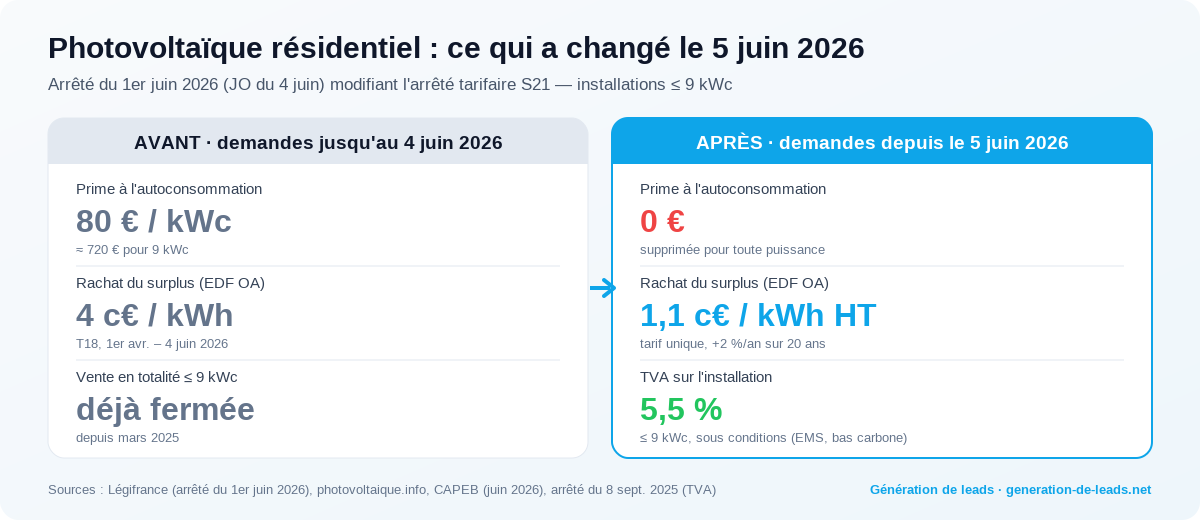
The bounty disappears, regardless of power
No new rates apply to new applications. Applications submitted before June 5th retain their subsidy and rate for 20 years: households that have already signed up are not affected.
The surplus is worth 1.1 cents/kWh, indexed at 2% per year
Indexation by the coefficient L is replaced by a fixed increase of 2% per year, which gives approximately 1.6 c€/kWh in year 20. Resale no longer finances the installation.
Sales remain completely closed below 9 kWp
Since March 2025, only self-consumption with injection of surplus is eligible for the purchase obligation for residential installations.
Reading a campaign provider, not a legal opinion: for a particular case (agricultural building, co-ownership, power greater than 9 kWp), have your offer validated by your federation or your council.
What arguments replace the bonus in your advertisements?
The central argument of a photovoltaic campaign in 2026 is the difference between the price of a kWh purchased from the grid and the price of a kWh injected: €0.2001 including VAT versus €0.011, a ratio of approximately 18 to 1. Photovoltaic self-consumption refers to the portion of solar production consumed directly by the home instead of being injected into the grid; each self-consumed kWh avoids the purchase of a kWh at the regulated tariff, set at €0.2001 including VAT for the 6 kVA Base option since August 1, 2026, according to CRE deliberation no. 2026-147 of July 15, 2026.
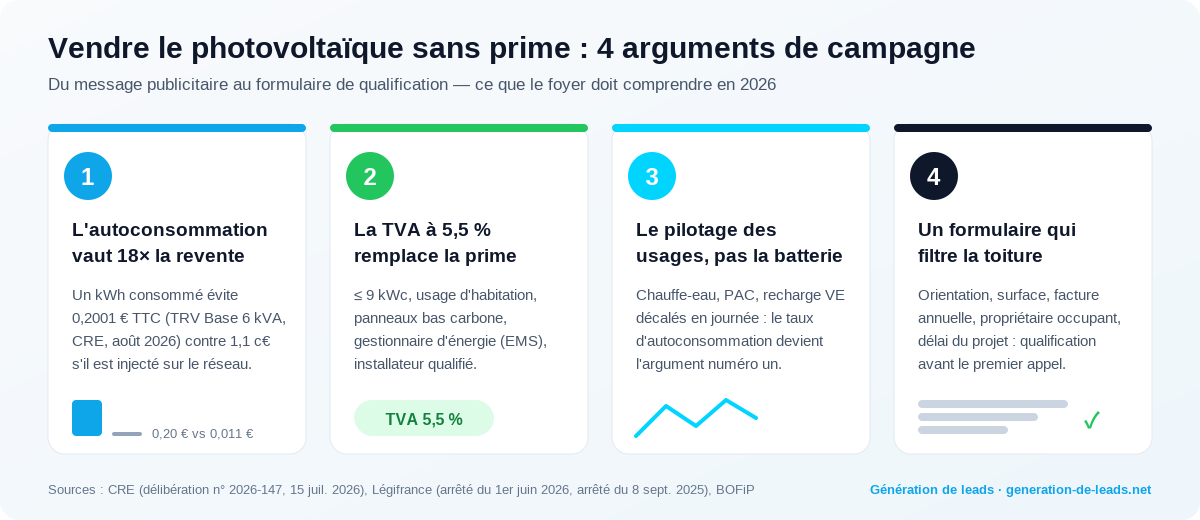
The kWh avoided, not the kWh sold
In the ad and on the landing page, talk about avoided bills and self-consumption rates. A household searching for «profitable solar panels 2026» has already read that the subsidy has disappeared: promising them assistance will scare them away.
The 5.5% VAT rate as proof of seriousness
This is the only significant state aid remaining for residential installations. It is only available to compliant installations (see next section): mentioning it demonstrates that your equipment and qualifications are up to standard.
Managing usage before the battery
Water heaters, heat pumps, and electric vehicle charging schedules shifted to coincide with production hours: the energy management system required for the reduced VAT rate becomes the selling point. The battery, however, remains taxed at 20% and must be covered by a separate contract according to tax regulations.
A form that filters the roof and the bill
Orientation, surface area, shade, annual electricity bill, owner-occupancy status, timeframe: these questions, asked on the initial form, eliminate north-facing roofs and tenants before the call. This is the principle behind our Exclusive solar panel leads.
The 5.5% VAT rate: the argument that requires a qualified installer
The reduced VAT rate of 5.5% has applied since October 1, 2025, to the supply and installation of photovoltaic panels of 9 kWp or less in a dwelling, provided that cumulative criteria are met; a single missing criterion brings the entire operation back to 20%. These criteria were established by the decree of September 8, 2025 (Article 278-0 bis of the General Tax Code) and supplemented by the 2026 Finance Law, which mandates the use of a certified or qualified installer.
For your advertisements, the difference is significant: on a 9 kWp quote, the difference between 20% and 5.5% VAT represents 14.5 percentage points of the pre-tax amount. This figure is not a «government-promised» subsidy but a rate stipulated in the French General Tax Code, making it an argument that the DGCCRF (French Directorate General for Competition Policy, Consumer Affairs and Fraud Control) cannot challenge, provided you only display it if your offer meets all the requirements. For all your trades, see our page leads for RGE installers.

Do your solar campaigns still mention subsidies?
I will check your Google and Meta ads, your landing page and your qualification questions (roofing, invoice, VAT) for free, and I will call you back within 24 hours with an action plan.
Method: a photovoltaic campaign without subsidies, step by step
A profitable solar energy campaign in 2026 targets households with high electricity bills and whose energy usage can be managed during the day, then qualifies them before the first call. Here's the sequence we apply to the Google Ads and Meta Ads campaigns for our installer clients.
Focus on the invoice, not the word «bonus».»
On Google Ads, exclude search terms like «self-consumption bonus,» «solar panel assistance 2026,» and «photovoltaic subsidy»: they lead to disappointed households. Instead, target «self-consumption solar panels,» «photovoltaic installer + department,» and «home solar panel quote.».
Write the landing page headline using the CRE figures
«Every kWh you produce and consume saves you from buying a kWh at €0.2001 including VAT» (CRE, August 2026). Date and attribute the figure: this is what makes the page credible and citable by AI engines.
Displaying the France Rénov’ mention is mandatory.
Since October 1, 2026, all advertisements for energy-saving or renewable energy production work must include the standardized statement with a link to france-renov.gouv.fr. Photovoltaics are included: see our article on the France Rénov’ mention required.
Ask six qualifying questions
Detached house, owner-occupied, orientation and roof type, annual utility bill, interest in remote control or battery power, project timeline. A household that answers these six questions has a genuine project.
Call back during the day and take measurements at the appointment.
Count your leads by cost per signed appointment, not by cost per form. The detailed calculation by profession is in How much does a lead cost per RGE (Recognized Environmental Guarantor) profession in 2026?.
On the technical side, a WordPress site that displays the France Rénov’ banner on all its pages can use the France Rénov' banner plugin for WordPress developed by Iotaweb, our partner from Guingamp (Côtes-d'Armor).
Mistakes that drive away households and the DGCCRF
The three most frequent mistakes in photovoltaic campaigns in the fall of 2026 are the promise of subsidies that have since disappeared, the advertised reduced VAT rate without meeting the eligibility requirements, and profitability calculations based on reselling surplus energy. Each of these costs leads, and the first two constitute deceptive business practices.
Exclusive photovoltaic leads, in your name
Campaigns, landing pages, and forms branded with your name, with no resale of your contact information. I'll start with a free audit of your current ads.
Frequently Asked Questions
Does the self-consumption bonus still exist in 2026?
No. The decree of June 1, 2026, published in the Official Journal on June 4, eliminated the investment subsidy for any complete grid connection application submitted from June 5, 2026 onwards, regardless of power output. Installations for which applications were submitted before this date retain their subsidy and purchase price for 20 years.
What is the buyback rate for surplus photovoltaic energy in 2026?
Since June 5, 2026, EDF OA has been purchasing surplus electricity at 1.1 cents/kWh (excluding taxes) for installations up to 100 kWp, with a fixed indexation of 2% per year over the 20-year contract. Before this date, the rate was 4 cents/kWh for installations of 9 kWp or less (period from April 1 to June 4, 2026).
Is it still possible to sell solar panels without state aid?
Yes, provided the argument is changed. Self-consumed kWh avoids the purchase of a kWh at €0.2001 including VAT at the regulated tariff (CRE, August 2026), which is approximately 18 times the buyback price. The 5.5% VAT rate remains available for residential installations of 9 kWp or less that meet the criteria, and usage management increases the self-consumption rate.
What are the conditions for the 5.5% VAT rate on photovoltaics?
A power output of 9 kWp or less, a residential building, modules with a carbon footprint of less than 530 kg CO₂eq/kWp and that comply with heavy metal limits, an energy management system, and, since the 2026 Finance Act, a certified or qualified installer. The battery remains at 20% and must be covered by a separate contract.
Sources: Order of 1 June 2026 amending the S21 tariff order (Legifrance), photovoltaique.info, details of the changes to decree S21, CAPEB, June 2026, regulated tariff as of August 1, 2026, CRE deliberation no. 2026-147 (Selectra), Conditions for the 5.5% VAT rate, decree of September 8, 2025 (Hello Watt), BOFiP clarifications and 2026 finance law (L'Officiel des métiers). This article is not legal or tax advice.