Implementation and management of SEA and SMO campaigns
campaigns and monthly management
Here's how a campaign setup and management process works. Each theme is different and has its own approach, but we have a general framework that allows you to anticipate the work involved. We'll mainly discuss Facebook and AdWords to stay focused on the main channels. This article can't detail all the possibilities, potential approaches, and intervention points; otherwise, it would be 50 times longer. We'll cover the fundamental principles for both AdWords and Facebook in general case studies.

Creating adsets and segmented ads
The initial setup is the most important; it will determine the success of your campaigns and their optimization potential. Empirically, the more we segment and personalize our approaches, the better we can tailor our targeting and improve performance.

Depending on the nature of the business and the products we need to advertise, we will conduct both semantic and persona analysis of the target audience. We will also create tailored Facebook ad sets and visuals, as well as ad groups and AdWords ads that are consistent with the product we are promoting. The entire system must be configured with conversion tracking. to lend credibility to any lead acquisition or sale. This allows the tools to learn on their own and optimize this segmentation; otherwise, the tool works blindly, including the service provider who has to perform the optimization.
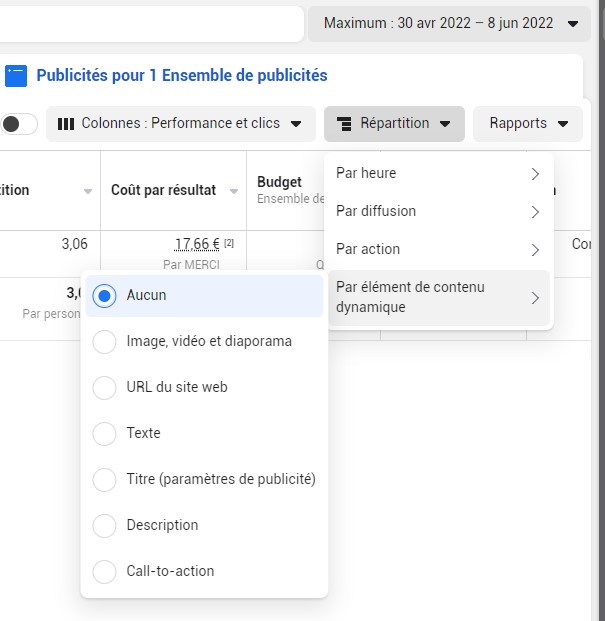
On Facebook, we compare several variations of titles, descriptions, and visuals using dynamic ads. These combinations can then be analyzed using the distribution filter. We can use the Facebook library to give us ideas on competitor performance and the state of the market in our area of expertise.
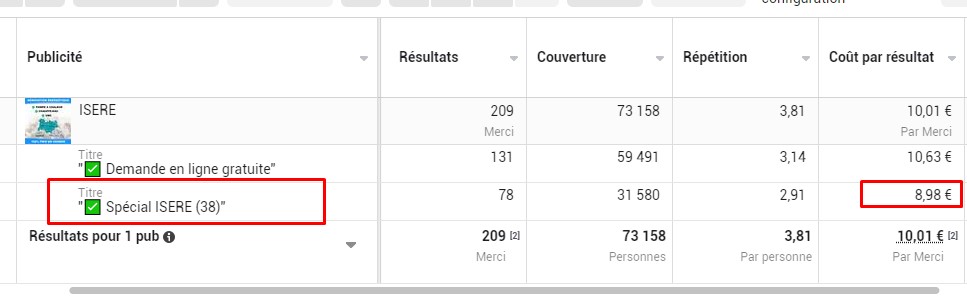
For example, here in this ad set, we can see that the "Special ISERE" title offers a slightly better CPA than "Free Online Application." This preliminary segmentation will allow us to make adjustments; this is just one example among many. We also note that this ad set targets ISERE and that several ads are linked to the account with segmentation by department, as this improves performance for this type of product (heat pump). We A/B test the audience, location, different visuals, titles and descriptions.
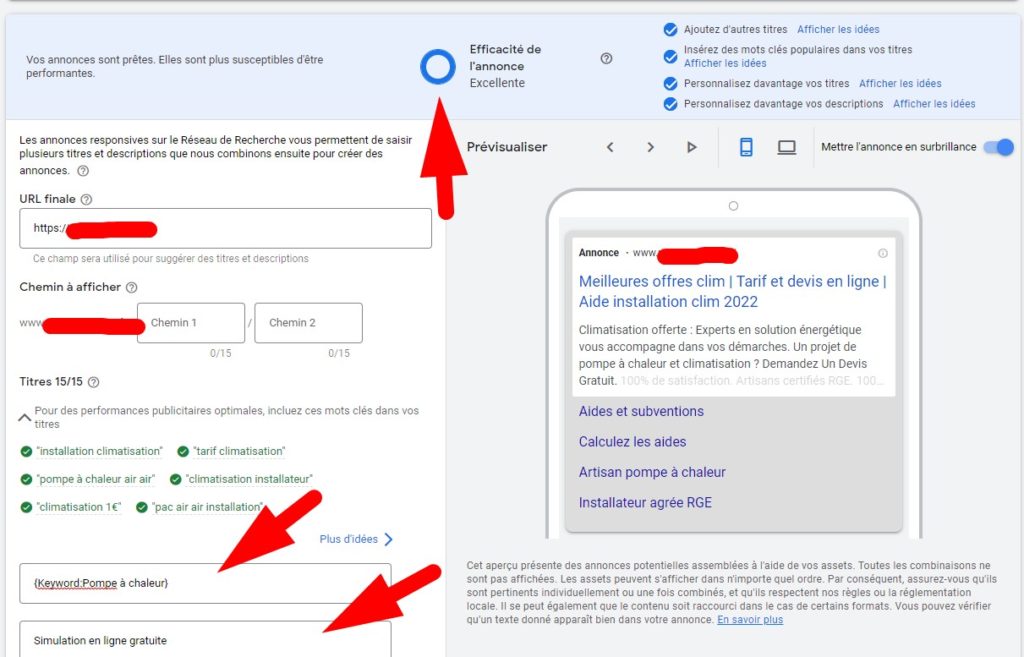
For AdWords, the same principle applies with responsive ads that work on combinations of titles and descriptions; don't hesitate to add the Syntax: {Keyword:} which allows CTR optimization with texts automatically replaced with the keywords that triggered their distribution.
Each ad can be segmented into different ad groups if the semantics differ. This is because ad quality depends on the consistency of keywords that match the titles and descriptions.
For example, for online training eligible for CPF funding: we work with groups of general keyword ads (e.g., "online training CPF," "eligibility test") and another group of exact match keyword ads (e.g., "CPF office skills training," "CPF Excel training"). We therefore have two different targeting strategies and results that can be analyzed separately. We naturally adapt the match types to work with both broad and exact match keywords depending on the potential volume and semantic quality.
How to work with search semantics?
Tools such as SEMrush, trends and planner tool They also allow us to estimate and help with keyword potential. Several approaches are possible, depending on the type of work to be done, the topic, the potential, the niche, etc. But in general, we prefer to work on broad/medium-tail keywords and then narrow down by excluding irrelevant search terms and isolating the search terms that bring the best results, converting them to exact matches. Prefer long keyword tails (minimum 3 keywords) and still qualify them at least a little at the campaign launch to avoid wasting money. But in the long term, it's better to target a broad audience at the beginning and then narrow down, rather than the other way around.
How to determine your advertising budget?
Several factors must be considered when determining your budget:
1: Your budget
Yes, it seems obvious, but before any launch, you inevitably have a predetermined budget. Depending on this budget and its size, we can plan more or fewer acquisition approaches and strategies. A client with a €400 monthly budget and a client with €10,000 will have very different strategies. With a €10,000 advertising budget, we could, for example, focus on Bing, native advertising, and explore other channels to complement the main ones.
2: Natural optimization
Each campaign and marketing channel has its own self-optimization algorithm. That's why we define a bidding strategy (based on performance, impressions, clicks, etc.). This strategy will automatically improve performance and reduce costs., This phase is considered complete after 2 to 4 weeks. And beyond that it's all upside, there's no limit, even after 6 months campaigns can improve without intervention.
3: The evolution of the campaign
A campaign that quickly generates leads and data will be more readily optimizable than a campaign with few leads or expensive leads. The quality of human intervention in making adjustments will allow us to see an increase or stabilization of the budget.
Generally, we start with a minimum of €30 to €100 per day, then scale in increments of €30 to €501. Every 3-4 days, depending on feedback and what the client wants. Some are very happy with €30 per day, because remember that the acquisition cost is not directly proportional to the allocated budget.
The more volume you want, the more budget is allocated, and the higher the CPA will be for the same environment. There are no perfect rules for determining the budget and how it will be used; it depends on the results at the time.
Be careful not to use too much granularity in your campaigns!
Too much segmentation kills segmentation, because you lose the natural optimization of each ad and ad group. Furthermore, a small budget spread too thin doesn't allow you to gather enough data for optimization and to draw conclusions about necessary adjustments. You won't be able to simultaneously test different areas, ad sets, landing pages, and objectives on Facebook without interdependence, and over too short a period. Unless you have a €20,000 budget for the first month, and even then... Hence the importance of working over the long term with optimization and monthly management. Let me give you a concrete example to illustrate this, using a B2C swimming pool seller in Lyon:
You want to test and segment, so you create several Facebook ad groups, like these:
- Buy a swimming pool for the summer – Facebook lead form – Visual pool ad set – Targeting homeowners and mortgage holders: Acquisition cost: €150 per lead
- -30% on swimming pools for the summer – Facebook lead form – Visual ad set for swimming pools – Targeting +35 years old without audience affinity: Acquisition cost: €90 per lead
- -30% on swimming pools for the summer – Landing page for pool purchase form – Visual adset for swimming pools – Targeting homeowners and mortgage holders: Acquisition cost: €50 per lead
How do you determine which elements of the combination work? Is the campaign with the €50 lead effective because we have a landing page? Or is it because we're using 30% with homeowner targeting? If you want an even cheaper lead, we need to know.
You need to be able to analyze and work with an environment that allows you to obtain readable and understandable results in order to improve and optimize.


Optimize campaigns and monthly management
A campaign launched with the best possible setup isn't optimal from day one. It's like a service provider being able to predict your future results: it's impossible. At best, we can have an empirical estimate. Even from one campaign to another with the same configuration, results can vary, because the slightest variable can change everything.
In order to work over the long term and achieve stability and good acquisition costs, it is necessary to maintain your campaigns and monitor them.
Adjust the environment, bids, and adsets
Whether you're using AdWords, Facebook, or any other acquisition channel, we have the KPIs that allow you to isolate and analyze ad performance. We have a multitude of parameters specific to each channel that we can use to improve performance.

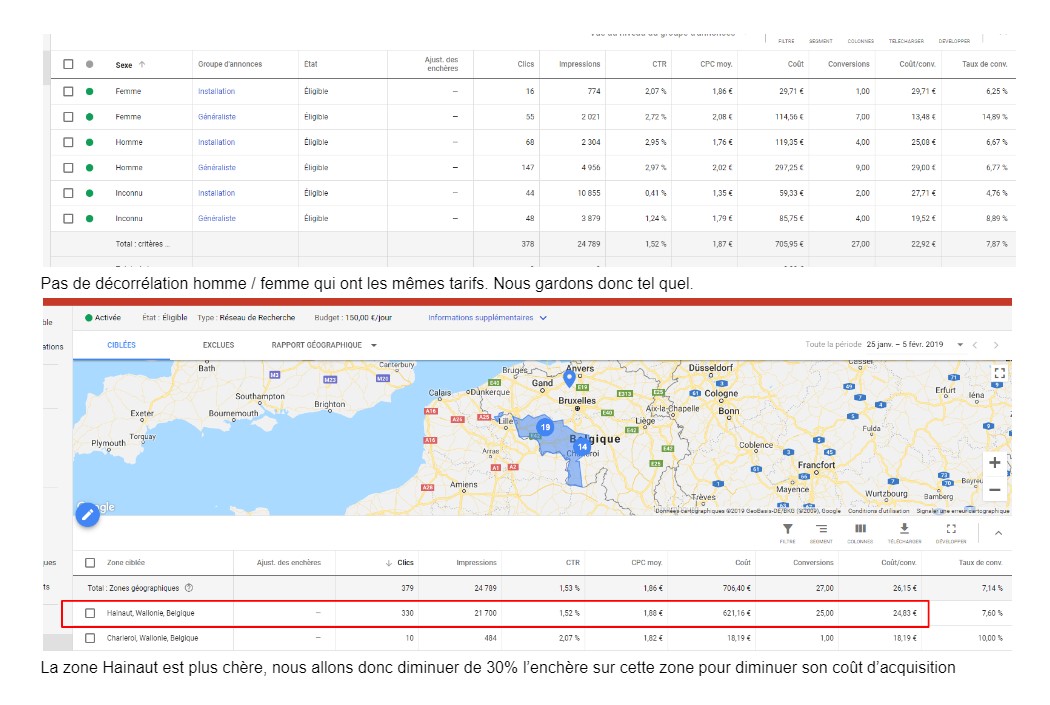
For example, here on AdWords we have results by device type. We had acquisition costs that were too high on desktop (because it's an emergency call-based service for finding a glazier), and the customer profile essentially corresponds to direct/urgent calls without using a computer. Since adjusting the -90% bids, we have a CPA that corresponds to mobile at around €11, whereas it was much higher before.
We do the same for everything possible: zones, calendar, days, audience affinity. For Facebook, it's the same with titles, descriptions, and images, allowing us to isolate the best results to continue improving.
A well-executed campaign allows us to obtain this segmented interpretation and thus improve performance in the long term.
Adset repetition rate, a nasty friend
You might think that once the campaigns are working, the costs are right, and the quality is good, then everything is settled? Not really, because after a while, your ads, especially on Facebook, will be seen and seen again and again by your audience. Too much repetition eventually leads to saturation of the same message and a drop in performance. It's like on TV: you don't see the same ads for two years in a row; it's temporary, lasting a few weeks, and then you revamp the visuals to retest and try a new approach. However, a minimum repetition rate is sometimes necessary to trigger engagement (so there's a happy medium to find, and it's determined by analyzing CTR, CPA, and ad quality metrics).
Optimize by excluding leads already acquired.
To optimize our budget, we don't want to continue showing our ads to those who have already purchased the product or visited the page. Therefore, we're adding an exclusion for visitors who have already shown interest in the project but are unlikely to return to complete a purchase. It makes sense to target people who haven't yet seen the ad; otherwise, we might as well use retargeting and personalize the message for abandoned shopping carts (promotional offers, for example).
Retargeting is useful in specific cases but is more expensive than acquiring a customer who discovers an advertisement. This is because someone who has already clicked on an ad is less likely to click on the same ad again than someone who has never seen or clicked on it.

Reporting and results
Benefit from agile feedback on results and optimization
To keep you informed of the progress of management and results, we can provide analytical feedback on campaign performance at a time of your choosing.
This will allow you to see the major operations carried out, the acquisition costs and the performance by ad groups or ad segmentations.